25 Sep 2026
Industrial autoclave used to bond laminated glass plies and interlayers

“Quarter-inch lami.” “Nine-sixteenths laminated.” “Three-eighths clear temp.” If you’ve ordered glass for any length of time, you know how much meaning gets packed into a few words, and how often those words get read differently. Terms vary from region to region, between imperial and metric, and even from one generation of glaziers to the next. When a description is vague, the wrong glass shows up and everyone loses time.

The National Glass Association (NGA) is working to fix that. Its technical paper Glass Nomenclature – Schema 1 (FB78-25), excerpted in Glass Magazine this summer, proposes a standard shorthand for describing glass makeups that anyone in the industry can read the same way. Here’s a quick guide.

The Basic Vocabulary

  • Lite: a single panel of glass, or a single panel of laminated glass.
  • Ply: one individual layer of glass or plastic within a laminate.
  • Laminate: two or more plies bonded together with interlayer material.
  • Interlayer: the bonding layer between plies. Besides holding the plies together, it can add performance such as penetration resistance, holding shards in place when the glass breaks, solar control, sound reduction, color or design.
  • Insert: a sheet or other material sealed inside the laminate, whether or not it covers the whole lite.
  • Kind: how the glass has been strengthened, written as a code: AN (annealed), HS (heat-strengthened), FT (fully tempered) or CS (chemically strengthened).

Why Metric?

The standard uses millimeters for glass, interlayer and airspace thicknesses. Metric numbers add up cleanly, so you can read the overall thickness of a makeup at a glance. If you think in fractions, here are the standard nominal equivalents for common flat glass thicknesses:

Imperial (nominal) Metric (nominal)
1/8″ 3 mm
5/32″ 4 mm
3/16″ 5 mm
1/4″ 6 mm
5/16″ 8 mm
3/8″ 10 mm
1/2″ 12 mm
3/4″ 19 mm

Writing a Single Lite

For a single (monolithic) lite, start with the nominal thickness in millimeters, then add the kind code. If there’s no kind code, the glass is assumed to be annealed.

  • 6 = 6 mm (1/4″) annealed
  • 10FT = 10 mm (3/8″) fully tempered, a common frameless shower thickness
  • 12FT = 12 mm (1/2″) fully tempered

To call out the glass material, add a code in braces after the thickness and kind. No code means clear. Common codes include CL (clear), LI (low-iron), BR (bronze), GY (gray) and GN (green). So 10FT{LI} reads as 10 mm fully tempered low-iron glass.

Surfaces and Coatings

Every lite has an outboard and an inboard surface, and either one can carry a coating or finish. In the standard, a surface code placed before the thickness describes the outboard surface; placed after, it describes the inboard surface. Codes include * for a low-E or reflective coating, r for mirrored, a for acid-etched, f for fritted, d for digital print and p for painted or roll-coated. When a specific manufacturer’s coating is used, its name goes at the end of the code after a double asterisk (**).

Writing a Laminate

This is where the shorthand really earns its keep. List each glass ply from outboard to inboard, separated by commas. Then add a hyphen, the interlayer thickness in millimeters to two decimal places, and the interlayer code: b for PVB, ev for EVA, ip for ionomer or u for polyurethane.

  • 3,3-0.76b = 3 mm annealed | 0.76 mm PVB | 3 mm annealed (6.76 mm overall, what many people call 1/4″ laminated)
  • 3,3-0.38ev = 3 mm annealed | 0.38 mm EVA | 3 mm annealed
  • 6FT,6FT-1.52b = 6 mm fully tempered | 1.52 mm PVB | 6 mm fully tempered

For laminates with more than two plies, list all the glass first. If every interlayer is the same, write it once: 6,6,6-1.52b. If they differ, list each interlayer in order: 6,6,6-1.52b,2.29b means 6 mm | 1.52 mm PVB | 6 mm | 2.29 mm PVB | 6 mm.

Why It Matters on Your Jobs

Compare “1/4-inch laminated” with 3,3-0.76b. The first leaves the ply thicknesses, strengthening and interlayer open to interpretation. The second leaves nothing to guess. That matters because:

  • Interlayers change performance. Interlayer type and thickness affect safety, sound control and how the glass behaves when it breaks, which can matter for code compliance.
  • Overall thickness has to fit. A laminate that comes in thicker than expected may not fit the glazing pocket or channel.
  • Clear specs mean fewer remakes. When everyone reads the order the same way, you get the right glass the first time.

You don’t need to memorize every code to order glass. But the next time you write up a laminated or coated makeup, spelling out each ply, its kind and the interlayer removes the guesswork, whatever format you use. The full NGA paper, including every material, surface and interlayer code, is free to download.

Not sure how to spec it? Call us at (972) 506-9580 or send us a message.

Source: “Glass Nomenclature,” Glass Magazine, National Glass Association, July 2026, excerpted from NGA Glass Technical Paper FB78-25.

25 Sep 2026
Modern bathroom with a frameless glass shower enclosure

Housing affordability comes up constantly in conversations with our customers, and it’s a top concern across the building industry. In a recent Window + Door blog post, editor Laurie Cowin looked at how affordability is squeezing would-be homebuyers and what it’s doing to window and door manufacturers. We wanted to take the same question and bring it home to Dallas-Fort Worth: what does affordability mean for the glass installers we serve?

The National Picture

Cowin points to work from Harvard’s Joint Center for Housing Studies, where senior research fellow Alexander von Hoffman has written about the disappearance of the moderately priced single-family home. His argument: builders have focused on the high end of the market for years, while older starter homes have been expanded or torn down and replaced with bigger ones. The result is a shrinking supply of homes that middle-income families can realistically buy. The National Association of Home Builders (NAHB) now lists housing affordability among its top priorities.

The NAHB/Wells Fargo Cost of Housing Index puts numbers on the problem. In the second quarter of 2026, a family earning the national median income needed 34% of its pre-tax income to cover the mortgage payment on a median-priced new home, and 36% for an existing home. For low-income families, the share jumps to 67% for a new home and 71% for an existing one.

How DFW Compares

North Texas is in better shape than many markets, but not by as much as you might think. In the same Q2 2026 index, a typical family in the Dallas-Fort Worth-Arlington metro needed about 30% of its income to cover the mortgage on a median-priced existing home. That’s right at the line: NAHB considers families who must spend more than 30% cost-burdened. Low-income families in DFW would need 61% of their earnings.

Local sales data tells the same story. According to the MetroTex Association of Realtors’ September 2026 report on the North Texas single-family market:

  • Closed sales were down 5% from a year earlier.
  • Pending sales fell 11%, and new listings dropped 10%.
  • The median sales price held flat at $390,000.
  • Days on market held at 58, with about 4.3 months of inventory.

In other words, fewer North Texans are buying and selling homes. Prices haven’t dropped, so buyers aren’t getting much relief, and many owners who might have moved are staying where they are.

What Manufacturers Are Seeing

Window + Door’s 2026 Top Manufacturers survey asked companies how affordability is affecting their business. Responses were mixed, but the companies feeling the squeeze described three trends:

  • Homeowners under financial strain have become much more selective about home improvement spending.
  • Customers are asking for lower-cost product options, and manufacturers don’t expect that to change soon.
  • With fewer homes changing hands, fewer sellers are replacing windows to boost resale value, and fewer new homes are being built.

The Other Side of the Coin

Here’s where the story gets more interesting for installers. When people can’t sell, or can’t afford to move up, many of them invest in the house they already have. Our Director of Sales & Business Development, Kristina Buckett, made that point in Glass Magazine’s 2026 Top Glass Fabricators Report. She credited strong shower enclosure demand to high-end remodeling and new construction, with homeowners upgrading windows and showers because selling has gotten harder.

The same report found that retrofit made up a larger share of fabricators’ business in 2025 than the year before. And over the long run, North Texas keeps growing: Census data cited in the report shows Texas among the top states for domestic migration in 2025. Those new residents need places to live, and the homes they buy or rent will need glass.

Where to Focus in 2026

If you install glass in DFW, here’s how we’d think about adapting:

  • Follow the remodel dollar. Frameless shower enclosures, bath mirrors, replacement window glass and decorative or pattern glass are upgrades homeowners see and use every day. Make them easy to buy from you.
  • Offer good, better and best. Price-sensitive customers still want choices. Showing a framed or semi-frameless enclosure next to a heavy frameless one, or standard clear next to low-iron, lets them pick a price point instead of walking away.
  • Sell energy savings. In a Texas summer, low-E glass helps keep heat out and cooling costs down. For homeowners watching every dollar, that’s a real selling point.
  • Be ready for value-focused builders. If more moderately priced homes get built, builders will be looking for cost-effective glass packages. Know your numbers and your lead times.
  • Keep a premium option in your lineup. High-end remodels are still moving. All-glass handrail systems from our Excel Glass Systems division give you an upscale upgrade to offer.

Whatever the market does, we’re here to help you bid it right. Call us at (972) 506-9580 or send us a message.

Sources: “Housing Affordability’s Impact,” Window + Door, May 2026; NAHB/Wells Fargo Cost of Housing Index, Q2 2026; MetroTex Association of Realtors, September 2026; “2026 Top Glass Fabricators Report,” Glass Magazine, March 2026.

25 Sep 2026
Two workers wearing cut-resistant gloves handling a large sheet of glass

Every lite that leaves our warehouse ends up in someone’s hands: your crew loading the truck, carrying it up a driveway, setting it in a frame. Glass is unforgiving when it’s handled wrong, and the injuries it causes are serious. So we were glad to see Window + Door recently share guidance from MyGlassFAB, the National Glass Association’s online training platform, on the basics of handling glass safely.

That guidance was written for workers on the fabrication floor, but the same principles apply in your shop, on your truck and on the jobsite. Here’s our installer-focused version, with a few field tips of our own.

1. Inspect Before You Lift

Damaged glass can fail suddenly while it’s being moved. Before you pick up any lite, look it over for these common faults:

  • Scores or cutting over-runs. A stray score line left over from cutting weakens the glass and can cause it to break when handled. The thinner the glass, the bigger the risk.
  • Cracks. Cracks are often tiny and can run farther than they first appear. A cracked lite can run or break almost as soon as you lift it.
  • Chips and shells. Because glass is stored and moved on edge, edge damage is common. If a chip looks like it compromises the lite, don’t lift it.

If you find a fault, mark it where others will see it (a white grease pencil works well), set the lite aside and tell whoever is in charge. Take edge damage on tempered glass especially seriously: tempered glass can’t be recut or re-edged, and a damaged edge can cause it to break without warning.

Field tip: Make inspection part of every pickup and delivery. Check edges and faces before the glass goes on your rack, not after it’s on the wall. If something doesn’t look right with glass you got from us, call us right away.

2. Gear Up

The right personal protective equipment is non-negotiable. Depending on the task, that can include:

  • Hard hat
  • Safety glasses or a face shield
  • Cut-resistant jacket or sleeves with neck protection
  • Cut-resistant gloves
  • Apron
  • Closed-toe work boots

Pay special attention to cut protection where major arteries run close to the surface: the neck, the upper inner arm, the inner thigh and the wrist. A cut in any of those areas can become life-threatening fast.

Before heavy lifts, take a couple of minutes to stretch your arms, shoulders, neck and lower back. The original article walks through a simple routine.

3. Know the Weight

No industry standard sets a maximum weight for a one- or two-person carry. That’s why every shop needs its own written guidelines covering which sizes and thicknesses one person can carry, when it takes two, and when to use mechanical help such as suction lifters or glass carts. Even if a lite falls within your company’s one-person limit, ask for help if you’re not comfortable carrying it alone.

Glass is heavier than most people expect. As a rule of thumb, flat glass weighs about 13 pounds per square foot for every inch of thickness:

Nominal thickness Approx. weight per sq. ft. 30″ × 72″ panel
1/4″ 3.3 lb 49 lb
3/8″ 4.9 lb 73 lb
1/2″ 6.5 lb 98 lb

Actual weights vary a little with glass type and actual thickness, but the point stands: a half-inch shower panel is close to 100 pounds before you add hardware, and it’s awkward to hold. Plan the carry before you start it.

4. Carry It Right

For a one-person carry:

  • Make sure your path is clear and no one is in the way before you lift.
  • Carry glass vertically. Never carry it flat, and never tuck it under your arm.
  • For small lites over short distances, use both hands, one on each side. Never carry glass one-handed.
  • For larger lites, put one hand palm-up under the bottom edge near the center, and use the other hand on the top or side edge for balance.
  • Hold the glass so that if it slips, you can let go and it falls away from you.
  • Keep the lite close to your body. Your shoulder can help support and steady it.

5. Out on the Jobsite

The fabrication floor is a controlled environment. Your jobsite isn’t. A few more things to keep in mind in the field:

  • Watch the wind. A large lite catches wind like a sail. On gusty North Texas days, get extra hands or wait for a calmer window before carrying big pieces outdoors.
  • Beat the heat. Glass sitting in the Texas sun gets hot enough to burn, and sweaty gloves lose their grip. Keep glass shaded when you can, and keep a dry pair of gloves handy.
  • Secure the load. Transport lites on edge, padded and strapped to your rack. Glass that shifts on the drive arrives with exactly the chipped edges you’re trying to avoid.
  • Check your suction cups. Clean glass and clean cup faces hold better. Test the seal before every lift.

Train Your Team

If you’re bringing on new crew members, don’t leave glass handling to on-the-job learning. MyGlassFAB offers an online course, “Handling Glass: Safety Basics,” free to National Glass Association members in good standing, along with other fabrication training. A short course and a written carry policy can save someone a trip to the emergency room.

Questions about thickness, weight or handling for an upcoming job? Call us at (972) 506-9580 or send us a message.

Source: “Best Practices for Safely Handling Glass,” Window + Door, National Glass Association, June 2026, courtesy of MyGlassFAB.

Featured photo: Shixart1985 via Wikimedia Commons, CC BY 2.0.

25 Sep 2026
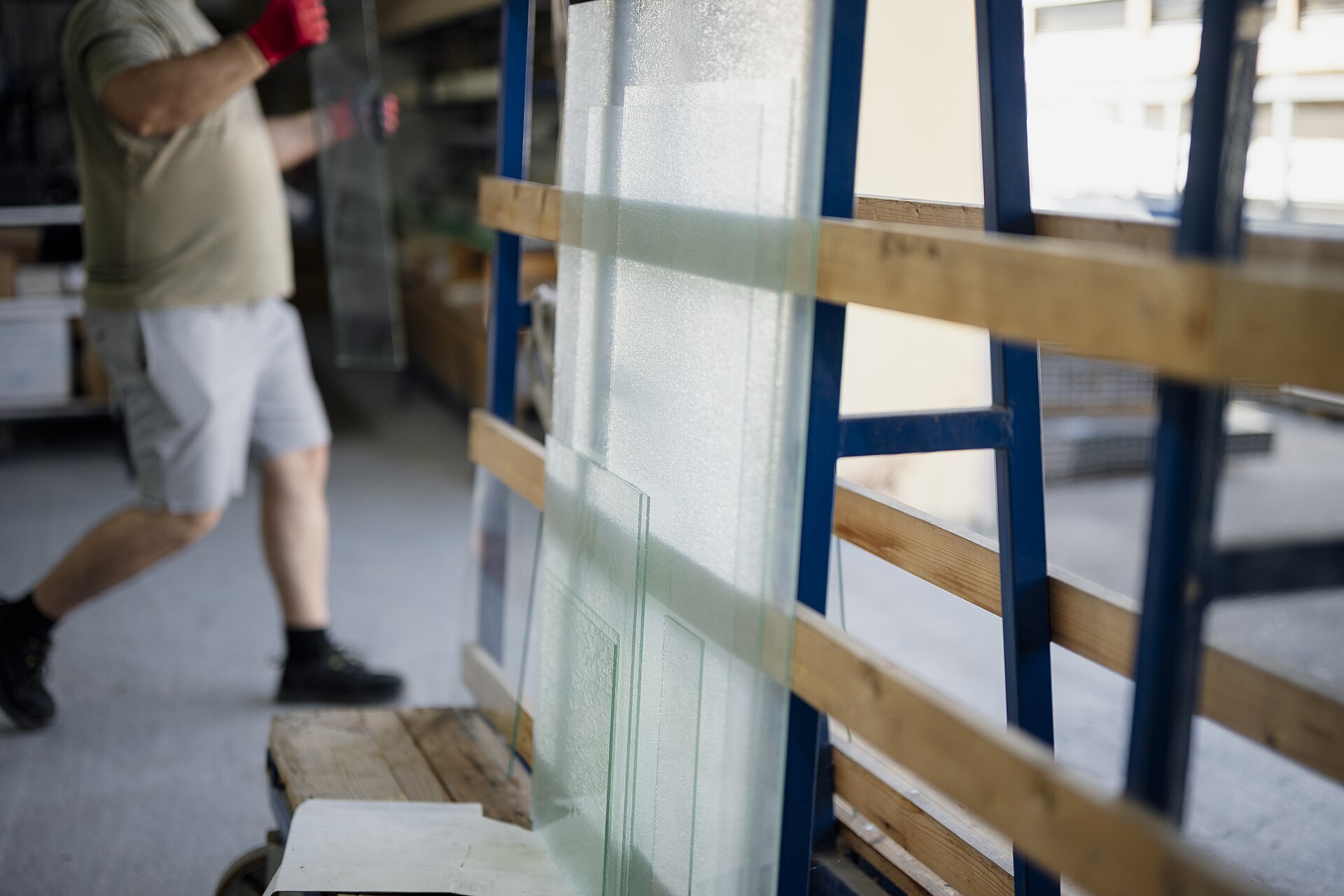
Worker moving large glass sheets stored on edge on a warehouse rack

Earlier this year, Glass Magazine published its 2026 Top Glass Fabricators Report, the National Glass Association’s long-running ranking of the leading architectural glass fabricators in North America. This year’s list includes 69 companies, and for the first time, Dallas Flat Glass Distributors is one of them.

We’re proud of that. We’re also clear about who earned it. For more than 25 years, our business has been built one order at a time by the glazing contractors, shower door installers, ornamental iron door shops and window manufacturers who trust us with their glass, from Durant, Oklahoma, down to Houston. This recognition belongs to you as much as it does to our team.

Our Take on Shower Enclosure Demand

The report’s Products section found that shower enclosures remain one of the biggest product categories for fabricators, with more demand than jumbo glass. Glass Magazine asked our Director of Sales & Business Development, Kristina Buckett, what’s behind it. She pointed to high-end residential remodeling and new construction:

“Since homes are struggling to sell, people are doing all they can to upgrade, including updating windows and shower enclosures.”

Kristina Buckett, Dallas Flat Glass Distributors, in Glass Magazine

That matches what we hear from installers at our shipping counter. Homeowners who might once have moved are staying put and investing in the house they have. A frameless shower enclosure is one of the most visible upgrades they can make, and that work lands with our customers, the local installers. Another fabricator in the report, The Glenny Glass Co., noted that demand for European-style shower doors keeps climbing year over year. If heavy shower glass isn’t already a big part of your business, it’s worth a look.

What the Report Says About the Market

The full report is worth reading, but these are the findings we think matter most to installers in North Texas:

  • Sales are recovering. 45% of fabricators reported higher sales in 2025 than in 2024, up 12 points from the prior survey, and 77% expect sales to rise again this year. Most describe their outlook as cautious due to rising interest rates.
  • Retrofit is a bigger share of the work. 64% of fabricators said retrofit made up anywhere from a quarter to all of their business in 2025, up from 46% the year before. When new projects stall, owners fix and upgrade what they already have.
  • Tariffs hit hardware and metal hardest. Tariffs on aluminum and steel climbed to 50% in June 2025, and fabricators named machinery, hardware and metal products as the most affected categories. The most common view was that tariffs also delayed or slowed projects. About 20% of fabricators changed where they buy glass last year, mostly because of price.
  • The South is growing. Fabricators working nationwide reported the strongest construction activity in the South and Sun Belt. Census data cited in the report shows Texas was among the states that gained the most residents through domestic migration in 2025.
  • Fabricators are investing. 82% bought capital equipment in 2025, mostly to add capacity and keep up with demand. Those holding off pointed to market uncertainty and tariffs on new machinery.
  • Labor is still tight. One in three fabricators said hiring got harder in 2025, with production workers and supervisors the toughest roles to fill.

What It Means for Your Business

Put those findings together and a few practical takeaways come into focus for DFW installers:

  • Follow the remodel. Shower enclosures, mirrors, replacement window glass and decorative glass are where homeowners are spending. Make sure your quoting and scheduling can keep up with more of that work.
  • Watch your hardware costs. With tariffs pushing hardware and metal pricing around, confirm current costs before you lock in a bid, especially on jobs that won’t start for several weeks.
  • Talk to us about lead times early. When we know what’s coming, we can help you plan around stock and delivery so your crews aren’t waiting on glass.
  • Don’t overlook commercial retrofit. Storefront updates and railing upgrades follow the same retrofit trend. Through our division, Excel Glass Systems, we offer all-glass entrance systems, with quick turnaround on standard Herculite door systems, plus glass handrail systems.

Thank You

Making this list is a milestone for a local, small-business wholesaler, and we don’t take it for granted. We’ll keep doing what got us here: stocking quality pattern, specialty, low-E, laminated, mirror and heavy frameless shower glass; keeping our ordering process transparent and our pricing competitive; and picking up the phone when you need us.

Ready to quote your next job? Call us at (972) 506-9580 or send us a message.

Source: “2026 Top Glass Fabricators Report,” Glass Magazine, National Glass Association, March 2026.

Featured photo: Shixart1985 via Wikimedia Commons, CC BY 2.0.